


Customer: Trevidia LTD
AWS Partner: SoftGEM Global Technologies LTD, AWS Advanced Consulting Partner
Industry: Financial services
Country: United Kingdom
AWS Region: eu-west-2 (London)
About Trevidia LTD
Trevidia LTD provides invoice management services to business clients in the United Kingdom, handling invoice generation, delivery, tracking and the records that sit behind them.
The Challenge
Trevidia ran its invoice management system on infrastructure that was becoming a constraint on the business rather than a support for it.
Invoice processing is periodic rather than continuous. Month end and quarter end generate volumes many times the daily average, and the previous environment was sized for those peaks all year.
Invoice records carry a statutory retention obligation, and personal and financial data within them falls under UK GDPR. The previous arrangement offered limited assurance on where data was held, how it was encrypted at rest, and whether a restore would actually work.
Recovering from a failure was a manual exercise with no tested procedure. For a business whose clients depend on invoices going out on schedule, an outage at month end is a commercial problem rather than an inconvenience.
Why AWS, and why London
SoftGEM assessed a like for like move of the existing environment onto virtual machines against a rebuild on managed AWS services. The like for like option was faster to execute but preserved the two problems that mattered: fixed capacity sized for month end, and a recovery path nobody had tested.
Region selection was a deliberate part of the design. Trevidia is a United Kingdom company handling personal and financial data of UK businesses, so the platform was built in the London Region. Data stays in the United Kingdom, which is a straightforward answer to give a client asking where their invoice records are held.
The Solution
Foundation
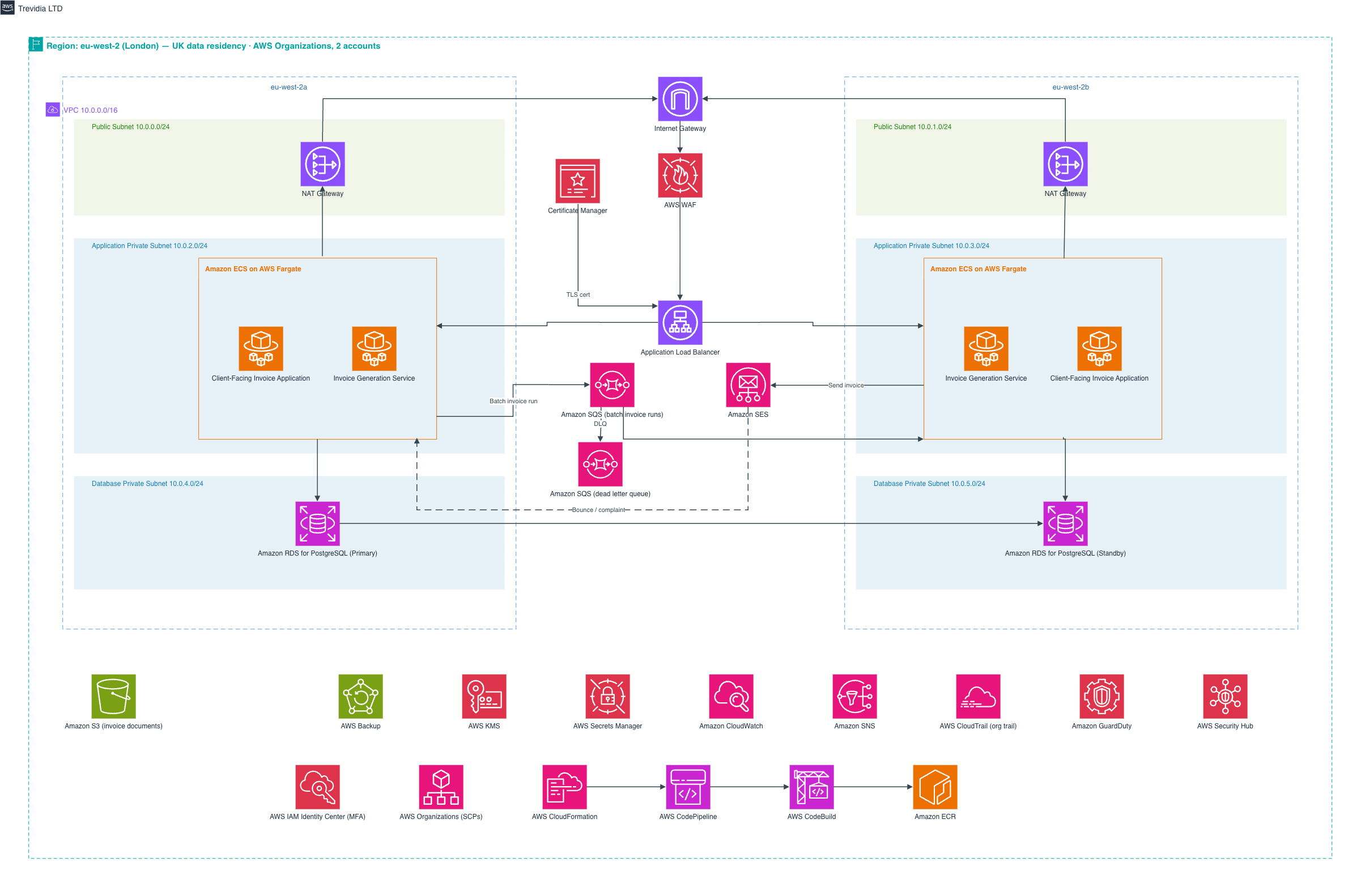
Two AWS accounts, management and production workload, under AWS Organizations with service control policies preventing changes to the audit trail, root account use, and deployment outside the approved Region. AWS CloudTrail records management and data events to a protected S3 bucket with log file validation. People reach the environment through AWS IAM Identity Center with multi-factor authentication and time bounded sessions. There are no IAM users for people and no long lived access keys.
Application Tier
The invoice application runs on Amazon ECS with AWS Fargate across two Availability Zones, behind an Application Load Balancer with AWS WAF and a certificate issued through AWS Certificate Manager. Invoice generation runs as a separate service from the client-facing application, so a large month end batch does not slow the interface.
Batch invoice runs are decoupled through Amazon SQS. Work is queued, processed and retried on failure, with a dead letter queue for anything that cannot be completed, so a transient fault during a month end run does not lose invoices or require someone to work out which ones were missed. Amazon SES handles invoice delivery by email, with bounce and complaint handling so undelivered invoices surface immediately rather than at the end of a payment cycle.
Data Tier
Amazon RDS for PostgreSQL in a Multi-AZ deployment with a synchronous standby in the second Availability Zone and automatic failover. Generated invoice documents are held in Amazon S3 with versioning and a lifecycle policy that transitions older records to archive storage, which keeps the statutory retention period satisfied without paying standard storage rates for records nobody reads.
Every store is encrypted with customer managed AWS KMS keys separated by domain, each with annual rotation. Encrypted database connections are enforced at the parameter group. Credentials sit in AWS Secrets Manager with automatic rotation and are retrieved at runtime.
Operations
Infrastructure is defined in AWS CloudFormation and deployed through AWS CodePipeline with template linting, security scanning and a manual approval gate before production. Production console access is read only, so changes arrive through the pipeline.
Amazon CloudWatch carries dashboards, alarms, container-level metrics and Synthetics canaries. Alarms notify the on-call engineer through Amazon SNS, and every alarm maps to a named procedure in an operations runbook covering daily checks, month end readiness, incident response by severity, and recovery. AWS Security Hub runs the CIS AWS Foundations and AWS Foundational Security Best Practices standards, and Amazon GuardDuty monitors for threats.
Architecture
Results
Capacity now follows the billing cycle. Month end and quarter end volumes are absorbed by automatic scaling and by queueing the generation work, so Trevidia is no longer paying year round for capacity that is needed a few days a month.
Invoice runs complete reliably. Work that fails in a batch is retried automatically and anything that cannot be completed lands in a dead letter queue for review, so a transient fault no longer means reconciling by hand to find out which invoices were missed.
Data stays in the United Kingdom, encrypted at rest under customer managed keys and in transit on every path, with retention handled by lifecycle policy rather than by manual housekeeping.
Recovery is automatic and defined. The database fails over to its standby without intervention, and recovery time and recovery point objectives are agreed and documented rather than discovered during an incident.
Operations are written down. Alerts resolve to named procedures, month end readiness has a defined checklist, and the platform can be run to a repeatable process rather than from memory.